

Decolonisation of assessment has many different meanings for learners and educators in higher education. For me, the term ‘decolonisation of assessment’ comes across as trou- blesome knowledge because I’ve so far had no experience of doing summative assess- ment, and only briefly participated formative assessment in my role. From researching the topic, reflecting on my own experiences as a technician and a student, I felt that a zine would be an ideal way to communicate my perspective.
Published on 9th November 2021 | Written by Liam Harrison | Photo by D Pl on Unsplash
From my experiences as an art student
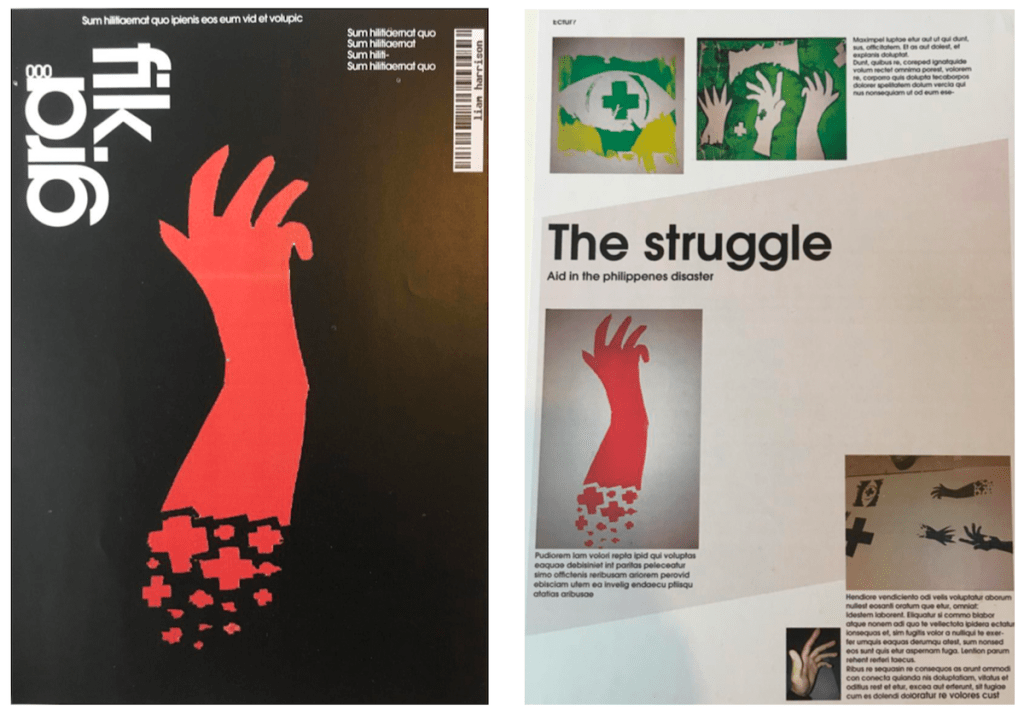
Photographs of some of my graphic design work from the UCA Foundation course (2014)
When I was a student I applied to BA graphic design and illustration courses at several of the major arts universities in London, after my A-levels and after completing a foundation degree in art and design. Up until this point I was confident my portfolio and sketchbooks were the best they could be, but I was rejected from every course and university I applied for. This was a major setback; I couldn’t understand what I’d done so wrong or if there was something I’d missed. From conversations with my team on the PGCE, it made me consider that there could have been a certain level or style of artistic thinking which was absent from all my work. As if there was a hidden practice or code which unfortunately after years of studying, I still hadn’t achieved.
This experience resonates with Charles’ view in which students “probably do not feel, as yet, that part of their participation in higher education is to question what is being pre- sented as the canon they must assimilate in order to progress successfully in their stud- ies.” (2019: 2) As a student I was led to believe that my work was at the right level. I’d nev- er thought critically about the subject and I would always look to the tutors to direct me for research; whether I liked it or not I always tried to follow their advice the best I could. Maybe the assessors at the universities picked up on this?
From my experiences as a technician
In my core role as a technician, the evidence of colonial systems and structures is less obvious. Reading UAL’s collaborative zine ‘Decolonising the curriculum’ helped me see where these issues could lie. It was fascinating to see the range of voices and “richness of experiences” Drisdale-Gordon, cited in UAL 2019: 1) across the student and staff com- munity. A student was quoted saying “unless you’re a fluent English speaker, a lot of the Asian students get left behind or left out… there is a huge cultural barrier in place” (The Attainment Gap Report 2019, cited in: UAL, 2019: 30).
This student’s experience has made me consider the inclusivity of my technical sessions; particularly the language, images and structure I use. The software or hardware used, guide sheets and video content are always in English which for students whose first lan- gauge isn’t English, may prove challenging to engage with. Perhaps I could change the way I deliver; using more visuals to describe techniques, offer more alternative and asking questions which can be answered through plain words. As an educator working in an in- internationalised institution, It’s important to “disrupt cultural imperialism that suggests one is worthy of being heard only if one speaks in standard English” (Hooks 1994).
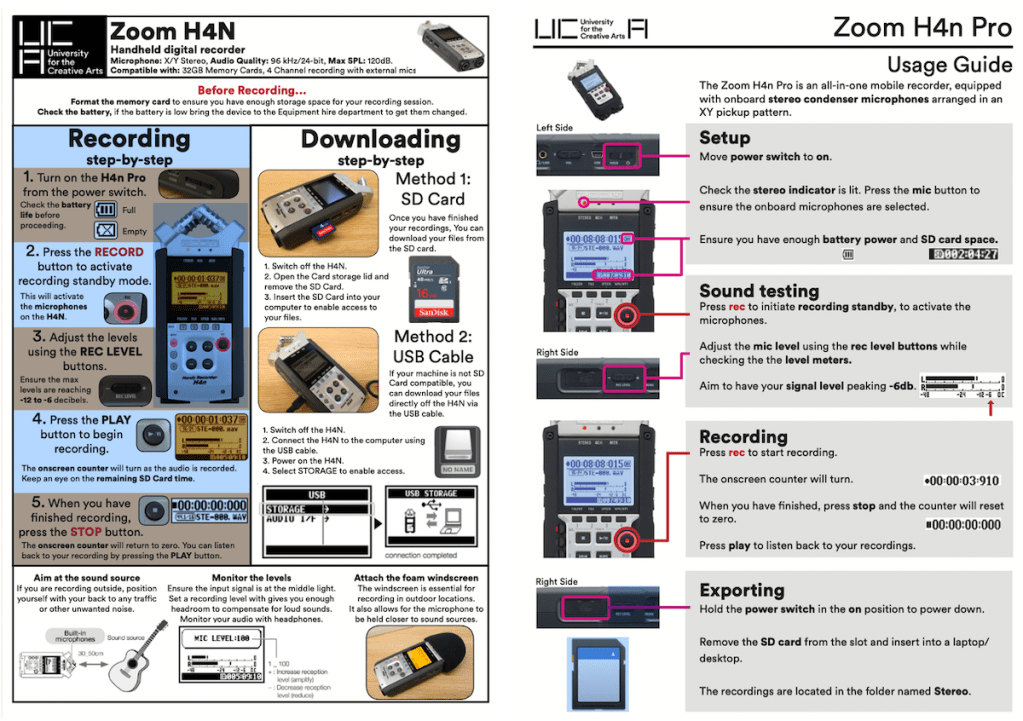
my re-designed, more inclusive guidesheet (2019)
For students whose prior learning or cultural experiences may be completely different from that of UCA, the drastic change in educational system could create barriers in their learning experiences. Keele University addresses this issue in their manifesto for decol- onising the curriculum, stating that decolonization should involve “identifying colonial systems, structures and relationships, and working to challenge those systems” (2018).
A privilege of my role is that I have the freedom to deliver sessions how I chose to, but there are systems out of my control as well such as the grading system or how an assignment brief is written. This is why it’s still important for me as a technician to provide perspective, guidance and clarity on the learning process in my sessions. This could be through explaining why the technology being taught, but also reiterating that other technologies and methods we don’t teach are just as valid, “adjusting the cultural perception” (Keele University 2018) that only one practice is acceptable.
Charles (2019: 4) stated that “as education has become increasingly global, communities have challenged the widespread assumption that the most valuable knowledge and the most valuable ways of teaching and learning come from a single European tradition”. This led me to consider adapting a snapshot of the Mona Lisa, as its cultural significance in art history made it an ideal symbol of the European tradition. My view in this zine is just a starting point; I need to understand the hierarchy, structure and composition of the systems in place before I can alter it.
Decolonisation of assessment should involve the exposition or translation of the hidden codes, languages and systems that form the assessment process. I think there is a certain style of analytical and academic thinking which universities look for in their students. Expecting students to achieve this without explaining why it is there can create barriers, especially for students whose first language isn’t english, or who’s prior cultural and educational experiences are different from the university.
About the author
Liam Harrison is a music producer and audio specialist at the University for the Creative Arts.
References
Charles, E. (2019) Decolonising the Curriculum. Insights 32 (1): 24. At: https://insights. uksg.org/articles/10.1629/uksg.475
Da Vinci, L. (1503-1519). Mona Lisa [Painting]. At: http://www.louvre.fr/en/oeuvre-notices/ mona-lisa-portrait-lisa-gherardini-wife-francesco-del-giocond
Hooks, b. (1994) Language. In: hooks, bell. Teaching to Transgress: Education as the practice of freedom. London and New York: Routledge. pp. 167-176.
Keele University (2019) Manifesto for decolonising the curriculum.
UAL (2019) Decolonising the Arts Curriculum Zine 2.
 JUICE
JUICE 