

In this paper the authors bring together two ongoing enquiries that are connected in a case study: firstly, how to teach experimental film practice and theory to students unfamiliar with this area, and secondly how might the teaching of a seemingly esoteric subject lend itself to inclusivity? They argue here that experimental film can be taught with inclusive practice as a primary goal. Their case study documents a range of approaches taken and tactics used during the design and delivery of an optional module for second year BA students on Digital Film Production at Ravensbourne University London. In this teaching structured play and careful framing of the idea of ‘experimentation’ was crucial, as well as positioning the module within the specifics of the wider Digital Film Production course.
Written by Alex Pearl and Richard Whitby | PUBLISHED ON 14th March 2025 | Image: ‘Liminal’ (2024) dir. Muskaan Mehmood (video still from 3.03 minute video) reproduced with permission from Muskaan Mehmood
Introduction
In 2024 the authors were invited to devise and teach ‘Experimental Film: Theory into Practice’, an optional module for level 5 Digital Film Production (DFP) students at Ravensbourne University London. Ravensbourne as an institution foregrounds its connections to industry and learning ‘industry standard’ skills and techniques is one of the big attractions of our courses. In contrast to this, our conception of the area of experimental film offers no such metric of competence and foregrounds process over technical achievement. The DFP course is structured around students identifying roles within more commercial productions; as cinematographers, writers, production designers, directors, etc. In this context ‘experimental film’ represents broad and heterogenous areas of practice that have not been part of the taught curriculum here for several years. ‘Theory’ has also been de-emphasised here and is sometimes presumed to be of little interest or even as obstructive to our students.
Twenty students chose our optional module which ran between January and April 2024. Overall, we feel it was a success, with some useful lessons learned; for ourselves and perhaps for other teachers as well, particularly where ‘avantgarde’, experimental or more outré creative practices may feel distant from the immediate ‘habitus’ of courses, staff and students (Reay, Crozier & Clayton, 2010). Although this was partly a self-selecting group (more on this below) who may therefore be assumed to have ‘included’ themselves, our hypothesis was that there are aspects of experimental film practice that are inherently inclusive, if taught carefully and deliberately put towards this goal.
What follows is a set of examples of things we tried, with reasonings for why we chose certain tactics and why we think they worked. Extra detail will be given on our tactic of setting rules and limits as a framework to include all students in experimentation and then on how we approached introducing experimental film contexts specifically with inclusion as a goal. Our module is by no means ‘finished’ and it will be revised for delivery in 2024/25. We will make points around inclusion here rather than explicitly anti-racist, decolonizing or anti-ableist pedagogy, although this area of teaching lends itself to these priorities too and these may be explored in future work (for a discussion of decolonizing processes in film education, see Mistry, 2021).
What we did
The module’s scheme of work was developed in informal conversations and we used a shared document adding suggestions for structure, activities, and screenings based on our own knowledge and interests but also what we thought we could expect through teaching their peers. Eventually we settled on an alternating structure whereby one of us would lead a session and then the other would take over the following week. This approach, in planning and in teaching, created a pedagogical pat-a-cake – a dialectic that was both inherently playful and reflected our desire to experiment with pedagogical methods in this module.
The table below represents our diagnoses of anticipated issues and our chosen tactics for inclusive teaching this area that went into our planning:
| In our experience, what can exclude students from this subject (and more generally)?Some relate to protected characteristics, some not and this is not intended as an exhaustive list. | What did we try? Some things were to do with content, some were design of learning activities and environments. |
| Esoteric language/ways of speaking not effectively ‘unpacked’. | Range of examples expanded to include DIY and no-budget filmmaking.(see section 2 below) |
| Not enough chances to ‘make subject their own’. | Four-hour sessions always broken into play, reading, watching, and developing own work. |
| Difficulties with theory and/or writing in combination with practice. | Framing of the ‘experiment’ was crucial – an experiment can fail. |
| Not understanding what is expected – i.e. “too much freedom”. | Rules and restrictions; short creative ‘challenges’ – attempting to free students from their usual habits, to come back around to personal projects. (see section 2 below) |
| Lack of diversity in teaching materials, and staff. | Wide-ranging videography(see section 2 below)Having two lecturers should help, despite both being white, male art-school graduates. |
| Access to resources. | Use of non-specialist equipment foregrounded. |
| Interpersonal issues in class. | No collaboration required for assessment (although certainly allowed). |
The following sections ‘Limits and Rules’ and ‘Offering Examples of Experimental Practice’ unpack two areas of teaching that particularly lend themselves to inclusivity.
Limits and Rules
Verna Myers’ analogy that ‘[d]iversity is being invited to the party, inclusion is being asked to dance’ (2016) is almost a cliché at this point and there are problems with the power dynamic set up with this image. Who ‘chooses the music’; where is the ‘dance’ happening – these are still imposed on the ‘dancers’? However, for our purposes here it can usefully apply to teaching, especially levels 4 and 5, and indeed our group responded well to having restrictions and limits on their experimentation – trusting us to choose the ‘music’ and ‘setting’.
This setting of rules of the game is highlighted as a principal element of play by Thomas Henricks, in Play Reconsidered, Sociological Perspectives on Human Expression. (2006). Here he describes rules as a framework which allow focus, repetition, and communication (2006: 14). While this formulation of play seems helpful in developing an academic rigour for play, our ‘rules’ were intended to create the shared boundaries of the playground, into which all students (and tutors) were invited.
Rather than delineating activities as acceptable or not acceptable the intention was to create a safe climbing frame for expression. This idea of a ground or frame for play also gave permission for them to play alone. Much of the DFP course demands group work, as is typical in the field (Prokopic 2021: 170) with structured roles of producer, director, cinematographer etc. In experimental film and ‘avant garde’ practice these roles are often combined, as filmmakers in this field work outside industrial modes of production and distribution (Rees, 2011: 2). Students who struggle with group work or just want a break from it were able to define their own parameters for their productions – most of which were carried out solo.
It might be assumed that all students choosing this optional module might want maximum freedom for their experiments, but it would be a mistake to assume that all students already know how to experiment in any given context. In our experience, this assumption may also disadvantage students with, for example, lower confidence, neuro-divergences or those studying in additional languages; whilst advantaging those with positive prior educational experience in the creative arts or support at home.
Pavel Prokopic frames an example of his film pedagogy in terms of setting ‘an inspiring creative limitation for students, which frequently serves within practice-based arts education as a tried-and-tested stimulant for creative practice’ (Prokopic 2021: 171). To aid creativity for all students, we set specific rules and limitations – in some senses gamifying experimentation (a related approach is discussed by Chambers [2020: 142], in reference to a film education project undertaken in Scotland with school-age participants called ‘Understanding Cinema’).
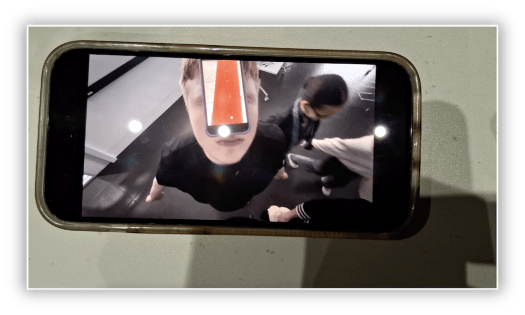
For example, the very first thing we did in session one (before any briefing or introductions) was a group exercise in which students shot footage on their phones and then edited by re-shooting from their screens; this process was repeated for a sound edit too. Shooting without extra equipment and without software means decision making is truncated and the work produced is outside students’ regular habits and perhaps aesthetic standards. This experience was open to be understood either as just an icebreaker, or one with aspects to be revisited.
Another popular (but optional) ‘limit’ was a suggestion to use analogue and/or outdated camcorder cameras rather than the industry standard equipment available from the University – this was made possible by Alex Pearl making his personal collection of equipment available to us (this also gave us a good chance to discuss a piece of theory: artist Hito Steyerl’s landmark essay ‘In Defence of the Poor Image’ [2009]).
In another session we asked students to design rules for each other which were written down and then randomly selected for each person (including us) to work within to make something new. Rules added anonymously and then picked out at random by students, and both tutors, to work by included:
- “One take per shot”
- “Film must be purple”
- “Must be constant speaking throughout”
- “Be uncomfortable while filming”
- “Do the opposite of the other rules”
We were forced out of our usual habits and interests. There was often a touch of playful sadism in the rules the students’ devised. Often the rules were vague or contradictory, often they were cruel (“Do five press ups every time you look at the camera.”) It was as if they wanted to discomfort their playmates (and us). This could have been in recognition of the inbuilt process of pushing beyond comfort that was central to our definition of ‘the experiment’ especially as it also pushed beyond the ‘industry focus’ of the rest of the DFP course. Although other modules also use restrictions to model students’ approaches and creative processes (for example, specifying a very low budget for a project), our option hopefully allowed some deeper reflection on the use of limitation to creative (or even absurd) ends, and perhaps will build students’ confidence setting their own limits in future projects (choosing their own ‘music’ to dance to, re. Meyers [2016]).
Offering Examples of Experimental Film Practice
Assessment was split between a practical film experiment and a written explanation of a. what was experimental in the work and b. a film context (wherever and whenever) for the work. For many teachers and practitioners, the term ‘Experimental Film’ will conjure artists such as Maya Deren, Michael Snow and Stan Brakhage – all of whom were included in our classes (also see Pantenburg, V. and Schlüter, S. 2018 for a similar list). Our students are very diverse; celebrated avant garde filmmakers less so – for example, AL Rees’ excellent book on experimental film [2011] is almost entirely focussed on white European and North American men.
However, we decided to extend the frame to include other kinds of filmmaking ‘experiment’ such as the no-budget action cinema of ‘Wakaliwood’ from Uganda, produced in conditions of extreme poverty (see Rose 2018). We proposed this mode as a kind of experiment, based on questions such as ‘can we realise a particular image with nothing but ourselves and what we have around us?’ We hoped to encourage students to be ambitious in their ideas using materials already available to them and far removed from the context of visual art that many experimental filmmakers have had proximity to but also, as part of an inclusive strategy, this extended definition allowed us to increase representation of work from the global majority and the global South.
We also chose to make a special screening of the film ‘Night Fishing with Ancestors’ (2023) by indigenous Australian group The Karrabing Film Collective, in agreement with the collective themselves. To viewers used to more mainstream storytelling, the film looks and sounds strange, whilst also being extremely lucid about its message. Mayes (2005: 149) highlights the importance of including different conceptions of time and story, as these are highly culturally specific, in his examples often leaving indigenous Hawaiian students excluded. We used this experimental, but still narrative, film as contrast to more mainstream forms of screen storytelling.
We also used it as a way into a conversation about post-coloniality and whiteness, alongside a reading from Bell Hooks, ‘Representing Whiteness in the Black Imagination’ (1992). This film explicitly explores this area of experience via experimental fiction. It was made collaboratively and marries form and content in a way particular to the experiences of the filmmakers. As in Hooks’s text, the film shows viewers (particularly white viewers) a picture of whiteness that is formed by the history of oppression of the collective’s community by white people. This particular example shows how theory and practice were brought together (as Romero Walker argues is key for more equitable film pedagogy; where media literacy and media production should go hand-in-hand [2022: 154]); specifically of how social contexts shape what is made within them. We also made it clear to students that their course had paid for the screening, making a direct, material connection between them and the filmmakers.
Results and Analysis: Examples of Student Final Projects
At the beginning of the module we asked the students their reasons for joining Experimental Film. These varied from an expressed interest in the subject to a generalised desire to make more of ‘their own’ films. As noted above, our students mostly were self-selecting. This does not mean that they had any prior experience of experimental making but should be taken into account when evaluating our results. Some had chosen the module because they had been unable to get onto the oversubscribed ‘Directing Fiction’ module.
This range of motivations suggests that whilst these students did not necessarily see themselves as potential experimental filmmakers they did want to make films with a high degree of authorial control. Nineteen out of twenty students passed the assignment (one withdrew from the University); we take this as a good indication that our brief gave each of them room to make something that held interest for them. Typically our students at RUL are very focussed on securing paid work in the more mainstream film industry (even before graduating) but still seemed to relish the chance to experience slightly different modes of making; several told us so in class (and several have returned to experimental modes in third year work, since).
We judge that pared down examples of productions from experimental makers acted as inclusive invitations for several of our students. Having a brief that could be carried out alone seems to have allowed them to explore processes and subject matter that may not have been achievable in a group project, which is often an exhausting challenge for students with significant learning differences and or social anxiety. In the context of ‘Hackathons’ (like film productions, situations where theoretical knowledge meets real world problems, in a collaborative setting) Rys, Górska and Korzynski establish that although collaboration is hugely valuable, anxiety and lack of confidence can get in the way and decrease educational benefit (2024).
We would argue that time away from group work can be valuable. In commercial-style film production on which much of our course is based, strict coordination of activity is absolutely central to shooting: in the film industry ‘time is money’, as the cliché goes (Mayes calls this conception ‘corporate time’ and sees it as a driving force in US education [2005: 143]). Fursman (2024) suggests that the time-based nature of moving image artwork (distinct from conventional filmmaking) offers a potential ‘piercing [of] durational standards’ (2024: 600) applied to students’ time in education (where, for example, punctuality and productivity with set time limits are often valued). We find that flexible, self-defined and solo-authored works offer a similar respite (‘pedagogy out-of-time’ as Fursman calls it) to our often anxious students; releasing them from shooting schedules, complex production coordination and kit store bookings.
Chambers (2020: 146) proposes that in the ‘Understanding Cinema’ project, participants ‘[e]xploring issues and experiences from their own lives, and subsequently seeing themselves on screen, seemed in many instances to be a significantly empowering experience’. In our module, the final projects produced often turned to very personal visions, in many cases representing the lived realities of our diverse group. As Romero Walker states:
‘As educators, it is vital that we begin teaching media production courses that are representative and inclusive to all […] this will provide an environment that invites diversity and inclusion in the classroom.’ (Romero Walker 2022: 165)
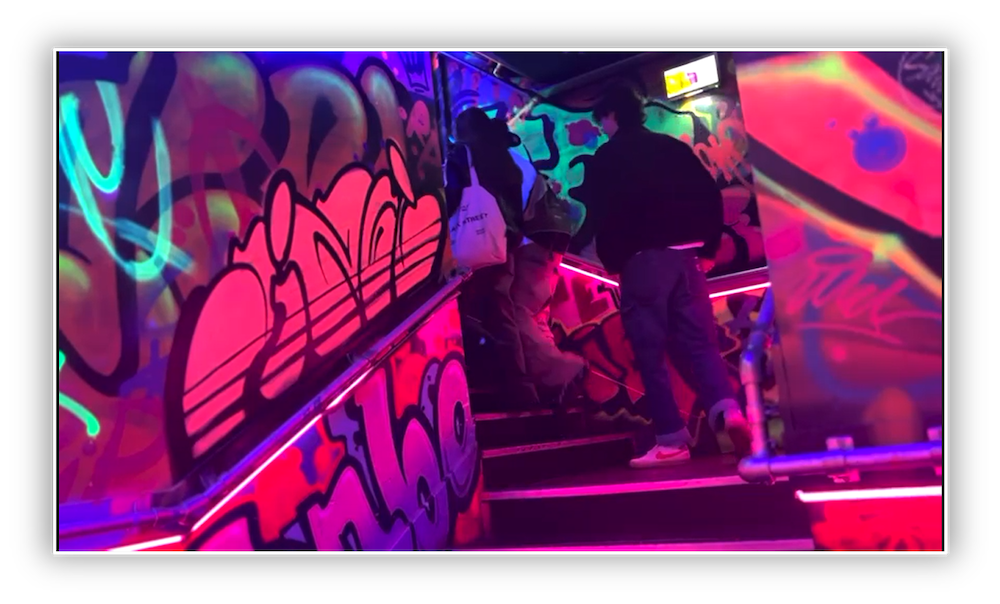
Our results align with this conclusion. One student made what we would describe as a poetic documentary, shooting footage with friends during their time socialising. This featured no real recordings of legible speech and was soundtracked with repetitive, looped incidental camera-audio to a disjunctive and unnerving effect; the unconventional edit and soundtrack both served to undercut the interpersonal warmth shown between participants in a manner we found to be meaningful and distinctive, especially since edit and sound are often conceived as simply articulating and supporting ‘story’ in more conventional drama or documentary film (as described in Readman 2003). Indeed, Pantenburg and Schlüter (2018) argue that a value of experimental film is that it often deviates from a logocentric emphasis on spoken and written language – in our teaching context, most obviously, the script.
Reproduced with permission from Muskaan Mehmood.
Another student used footage taken of themselves whilst a child, projecting it back onto their own body and reshooting it, to explore how their identity had changed. This project was developed in a good example of constructivist learning (Biggs 1996), demonstrating the student’s competence in setting their own technical and conceptual parameters, rather than working within those set for them. It is also clearly represents an example of a student making sense of their own life and experience, within what Mayes calls a ‘self-actualizing curricula’ (2005: 147)
Both these projects achieved high marks, not because the resulting films matched a metric of ‘quality’ we had set, but because they demonstrated genuine experimentation and openness in specific parts of their process. We further believe that these exemplary projects align with the proposed benefits of ‘affective learning’ (Devi Mahadeo, J & Nepal, R 2023) as they clearly show students engaged in their filmmaking on an emotional level.

Reproduced with permission from Sid Howard.
Conclusions and Future Developments
Our reflections on the module were, like its planning and delivery, developed informally. Again we used the shared document as a place to pass ideas back and forth, to recall events and develop our thinking. The information collected here was also presented to colleagues at Ravensbourne University in the context of general staff training. Our option received positive feedback from students, course leader and our external examiner and will run again. The external examiner, as well as agreeing that the module offered opportunities for engagement with EDI, noted that the work produced was ‘of good quality’ and this was reflected in the grading.
Nevertheless, there is much room for greater inclusivity in terms of set reading and viewing, and reordering content based on our observations. For example, this time, our class did not really take advantage of an invitation to bring in their own examples of experimental film. We need to consider further ways of encouraging students to make their own associations and to make contributions collectively. Also, although we included examples of decolonising and anti-racist practice such as Karrabing’s film, this aspect could be developed and foregrounded, alongside anti-ableist projects. As others have proposed (eg. Romero Walker 2022), a more equitable film pedagogy requires a questioning of dominant film technique and thinking; experimental film practice can be a way to begin.
The question that follows here is: would any of these tactics and methods be beneficial for all DFP students at Ravensbourne? We believe that offering a contrasting mode of production (ie. potentially solo instead of necessarily collaborative) inherently increases the range of types of learning for these students Our results support what Pantenburg and Schlüter (2018) suggest: that experimental films allow engagement with the fundamentals of filmmaking and cinema. They are ‘films that teach about film’ (Pantenburg and Schlüter 2018: 121), in what can be a very direct and potentially accessible way; in our view well suited to the overall aim of inclusive pedagogy. We are teaching in the context of many challenges to established modes of film production and distribution; it may be that experimental film’s questioning of these may be more valuable than ever.
We have also found opportunities for ‘self actualisation’ (Mayes 2005) valuable even within a creative course such as DFP. As these students complete their third year, and the following year take up an option to explicitly pursue an ‘experimental’ final major project, we will have more data to consider but what we have learned so far is encouraging, and has led to the term ‘experimental film’ being used more frequently in other briefs. We are looking forward to running this teaching again and hope that there might be simple lessons for others within what we have tried.
About the authors
Dr Alex Pearl is an artist working across installation, video, animation, and performance. Alex completed a practice led PhD at Manchester Metropolitan University in 2018 on mechanical breakdown and anthropomorphism. Research interests include practice as research, technology and agency and the afterlife of images in the digital realm. Alex exhibits regularly nationally and internationally. He teaches at Ravensbourne University London.
Dr Richard Whitby is an artist working in video and live performance. Richard completed his PhD at the London Consortium in 2016 on arena-based adaptations of screen narratives. Research interests include post-cinema, experimental film, urban regeneration. In 2019 Richard was awarded a Jerwood FVU commission that resulted in the film ‘The Lost Ones’ and he releases music with Bulkwash. He teaches at Ravensbourne and at University of the Arts London.
References
Instructional Design.org (n.d) Constructivist Theory (Jerome Bruner). Instructional Design.org
Bruner, J. (1990) Acts of Meaning. Cambridge, MA: Harvard University Press.
Davies, D., Jindal-Snape, D., Collier, C., , Digby. R., Hay, P., Howe, A. (2012) Creative learning environments in education—A systematic literature review. Thinking Skills and Creativity, 8. 80–91.
hooks, b. (1994) Teaching to Transgress: Education as the Practice of Freedom. London, Ney York: Routledge.
Livingston, L. (2010) Teaching Creativity in Higher Education. Arts Education Policy Review, 111(2), 59-62.
Mcleod, S (2023) Jean Piaget and his Theory & Stages of Cognitive Development. Simply Psychology
Nordell, J. (2021) The End Of Bias: How We Change Our Minds. Granta Publications Ltd.
Ortquist-Ahrens, L., & Torosyan, R. (2008) The role of the facilitator in faculty learning communities: Paving the way for growth, productivity, and collegiality. Learning Communities Journal, 1 (1), 1-34.
Parrish, P., & Linder-VanBerschot, J. (2010) Cultural dimensions of learning: Addressing the challenges of multicultural instruction. The International Review of Research in Open and Distributed Learning, 11(2), 1-19.
Radclyffe-Thomas, N. (2014) Is Creativity Lost in Translation? A discussion of the cultural underpinnings of creativity. JOMEC, 6.
Radclyffe-Thomas, Natascha (2015) Fashioning cross-cultural creativity: Investigating the situated pedagogy of creativity. Psychology of Aesthetics, Creativity and the Arts, 9 (2), 152-160.
Regmi, D. K. (2012). A Review of Teaching Methods – Lecturing and Facilitation in Higher Education (HE): A Summary of the Published Evidence. The Journal of Effective Teaching, 12, 61-76.
Rogers, C. R., & Freiberg, H. J. (1970). Freedom to learn. Columbus, OH: Charles Merrill.
Thompson, M (2019) Education Reimaged Through Constructivism. TEDxBethanyGlobalUniversity [Video] YouTube.
Bibliography
Biggs, J. (1996) ‘Enhancing Teaching through Constructive Alignment’ Higher Education Oct., 1996, Vol. 32, No. 3 (Oct., 1996), pp. 347-364 Published by: New York: Springer
Chambers, J. (2020) Consolidating an experimental pedagogy: Exploring ecologies of film education within France’s Cinéma Cent Ans De Jeunesse and Scotland’s Understanding Cinema project(s) between 2013 and 2019. Film Education Journal, 3 (2), 138–59.
Devi Mahadeo, J & Nepal, R (2023) What is affective learning and how can it foster engagement and critical thinking. [online] THE Campus Learn, Share, Connect. [Accessed 1st February 2025]
Elwes, C. and Shirin Neshat (2006) Video art a guided tour. London, B. Tauris.
Fursman, J. (2024) Out of Time, Pedagogy, Temporality and the Affective Encounter. Film and Moving Image Making Practice in Art Education. International Journal of Art & Design Education
Henricks, T. S. (2006) Play Reconsidered: Sociological Perspectives on Human Expression. United States: University of Illinois Press.
hooks, b. (1992) Representing Whiteness in the Black imagination. New York; London: Routledge.
Howard, S. (2024) Places I’ve Been [digital video] Unpublished.
Karrabing Film Collective (2023) Night Fishing with Ancestors. Northern Territory, Australia: Karrabing Film Collective.
Pantenburg, V. and Schlüter, S. (2018) Teaching experimental film: On the practical and analytic treatment of avant-garde cinema. Film Education Journal 1 (2): 115–132.
Prokopic, P. (2021) Exploring the application of practice-based research on affective cinema to the teaching of creative cinematographic techniques within UK higher education. Film Education Journal, 4 (2), 170–83.
Mayes, C (2005) Teaching and Time: Foundations of a Temporal Pedagogy. Teacher Education Quarterly, Spring 2005. 32(2), pp. 143-160.
Mehmood, M. (2024) Liminal [digital video] Unpublished.
Mistry, J. (2021) Decolonizing processes in film education. Film Education Journal, 4 (1), 1–13.
Readman, M. (2003) Teaching Scriptwriting, Screenplays and Storyboards for Film and TV Production. London: BFI.
Reay, D., Crozier, G., & Clayton, J. (2010) Fitting in or ‘standing out’: Working‐class students in UK higher education. British Educational Research Journal, 36(1), 107-124.
Rees, A.L. (2011) A history of experimental film and video. London: BFI.
Romero Walker, A. (2022) A more equitable film pedagogy: Including media literacy in higher education film classrooms to result in better media practitioners. Journal of Media Literacy Education, 14(1), 153-167.
Rose, S. (2018) Welcome to the action packed world of ‘Wakaliwood’. [online] CNN. [Accessed 14th August 2024]
Rys M.,Górska, A.M. and Korzynski, P. (2024) Navigating the hackathon: Exploring participant experience, confidence and anxiety. European Journal of Education. 59(3).
Steyerl, H. (2009) In Defense of the Poor Image. [online] e-flux. [Accessed 14th August 2024]
 JUICE
JUICE 